Monsters
Miss Peregrine's Home of Peculiar ChildrenMonsters are at once the supernatural pursuers in Abraham Portman’s stories and an image for human cruelty. As Jacob Portman learns the truth behind his grandfather’s childhood, the meaning of the word shifts: the imagined creatures give shape to fear, but the human perpetrators of wartime persecution prove more terrible than the fantasy. In the present, the Hollowgasts make that old fear literal again, connecting family memory, historical violence, and Jacob’s own danger.
The childhood stories
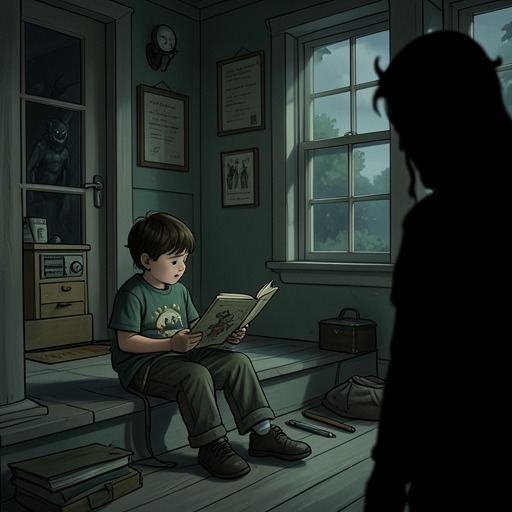
Abraham tells Jacob that he was born in Poland and, at twelve, sent to a children’s home in Wales because monsters were after him. He describes them as hunched, unnatural beings, and turns the story into a game by shambling after the young Jacob as if he were one of them. The tale is frightening and playful at once: Jacob laughs and runs, yet Abraham’s increasingly elaborate descriptions stay with him after the storytelling ends.
The creatures acquire details with each retelling. Abraham says they are difficult to see, that their shadows betray them, and that dangerous tentacles can emerge from their mouths. At night, Jacob’s imagination makes ordinary sounds and shadows seem like signs of their approach. He is frightened by the monsters, but also thrilled by the idea that Abraham had fought them and survived. The fear and admiration are inseparable: the monsters give a child-sized form to dangers Jacob cannot yet understand, while his grandfather becomes the brave figure who escaped them.
From fairy tale to history
As Jacob grows older, he decides that Abraham’s stories and photographs are fabricated. Abraham accepts the accusation without arguing, and the subject falls silent. Jacob later learns from his father that the stories were not simply lies: they were exaggerated versions of a real childhood shaped by war. Abraham was the only member of his family to escape Poland before the Second World War. At twelve, he was sent to Britain by train with a suitcase and the clothes he wore; he never saw his parents or older brothers again, and his relatives were killed before he turned sixteen.
The revelation changes the referent of the monsters. The human perpetrators were not the fantastical beings of Jacob’s childhood imagination but men in uniforms, acting together in a way that could appear ordinary until their violence became unmistakable. Abraham’s monster stories therefore preserve a truth through disguise: their supernatural imagery makes terror tellable to a child, while the later disclosure restores the historical reality beneath the metaphor. The shift is not a rejection of the earlier stories so much as a recognition of what they were carrying.
The enchanted haven and its hunted children
The Welsh children’s home belongs to the same imaginative vocabulary. Abraham describes an island of unending sunshine, children who never fall ill or die, and a large house protected by a wise bird. Its enchanted safety contrasts with the danger from which he escaped. Jacob later understands the paradise as a transformed account of refuge: compared with mainland Europe, the home could seem like a haven, and Abraham’s stories rendered its protection as magic.
That language also transforms the children themselves. Their supposed extraordinary powers belong to the fairy-tale version; the account identifies their persecution with their Jewishness and their status as orphans of war. Their survival, after the violence of ghettos and gas chambers, is the real wonder. The story thus places the monsters on two levels without treating them as interchangeable: supernatural danger belongs to the novel’s fictional world, while human persecution has a specific historical source and consequence.
The threat returns
The word’s supernatural meaning becomes immediate when Abraham, increasingly affected by dementia, tells Jacob that they are coming for him and asks what he can fight with besides a butter knife. His warnings are no longer stories told from the distance of childhood. The decline makes the old monster narrative oppressive and urgent to him, even as Jacob initially understands it as part of his grandfather’s worsening condition.
After Abraham dies, Jacob senses that something is in the woods. He raises his flashlight toward a figure resembling the nightmare creatures Abraham described: a hunched form with dark eyes and a mouth from which long, eel-like tongues emerge. Jacob recognizes the danger, but Ricky cannot see what Jacob sees; Ricky fires toward the movement and asks what was there, while Jacob remains unable to explain. The encounter establishes that the childhood monsters are not only metaphorical or remembered: a Hollowgast is present, and Jacob can perceive it.
Persecution, concealment, and legacy
Later, Miss Peregrine explains that Abraham knew the stories were true and may have kept them from Jacob to protect him. Abraham had faced persecution as a Jew during the Nazi era and as a Peculiar hunted by Hollowgasts. The monsters therefore refer to threats that overlap in his life but remain distinct in their causes: Nazi rule ended, Miss Peregrine says, while the Hollowgasts emerged stronger, leaving Peculiars to remain in hiding.
Abraham’s response was to refuse a hidden life. He returned from the war changed, became a warrior, and determined to build a life outside the loop; Emma says that she and the others begged him not to go to America. Against that history, the monster stories become both a protective inheritance and a painful one. They obscure details Jacob is not yet ready to know, but they also carry forward the danger Abraham fought. Their eventual reinterpretation makes Jacob’s inheritance more than a family secret: he must confront the literal Hollowgast and the human history that gave his grandfather’s stories their terrible weight.